When I think about grabbing my backpack, I feel a shiver of excitement that slowly, almost like an imperceptible tickle, stirs the soul deep down.
STOP: a rational hesitation follows, a kind of automatic impulse to not move, to not change place: « but who's making you do this?! In the last few years all you've done is travel: planes, trains, cars... rest a bit at home for a while... come on! ».
All of that dissolves the instant I mentally project myself sitting on the train and I let my imagination free, taking the initiative of painting a picture whose frame has the shape of the rails of a line without borders: from Policoro to Roma, from Roma to Milano, from Milano to Amsterdam, without missing some place to visit for one reason or another in the middle of each stretch. And so, without any solution of continuity, I lose myself in decidedly fanciful planning.
Now that I think about it, jotting these (extravagant) ideas down on paper (or keyboard), several people I've grown closer to lately have travelled long distances by train. I think of my friend Erik, half Dutch, half French; of my Dutch friends Annabel and Stella. All three of them dancers and wonderful people who chose to reach Policoro for the swing festival that takes place every year, in the last week of August, Policoro in Swing. Starting from Holland, the two Dutch girls crossed, on separate legs, several countries including Germany, Switzerland and Italy in full, arriving eventually right in Policoro, on the Ionian Sea. Talking with them, it seems the choice was moved by a sense of responsibility for the environment, preferring means that are more environment friendly, but also for the possibility of stopping in more places along the route, and getting to know new places, new people, new cultures.
Another clear sign that reality is nudging me and inviting me to jump on a train is "hidden" in the book that, even though I received it as a gift more than twenty years ago, only lately I decided to start reading.
Around the World in Eighty Days, by Jules Verne.
I stay truly puzzled if I think that I received it as a gift from my elementary school classmate, Franco (Francesco) Russo, on the day of my birthday, 21 December... which year? I'd dare say 2001. The last year of middle school. Maybe it was 2000, I'm not sure.
I stay puzzled precisely because the protagonist, Phileas Fogg, mysterious English aristocrat, entrepreneur and benefactor, decides, in a faraway London of 1872, to accept a crazy bet with gambling colleagues that sees him involved, together with his new butler, in the attempt to complete the tour of the world in eighty days, relying only on trains and ships.
The puzzling part is that the bet will be won if the two reach London, the place they started from, exactly on the day of my birthday, that is 21 December. The very same day I received the book as a gift.
These moments are enlightening and reassuring precisely because there's no longer need to ask oneself what to do: reality walks with you in the chosen direction. "By whom" isn't for us to know but, at this point, what would it matter?!
The moral of the story is that books are a unique revelation, as long as they arrive in the right place at the right moment.
A bit like when, prey to the strangest mental idiocies, I kept asking myself along the Via degli Dei, in April 2022, if and why I found myself on that path, and if and why I should keep walking.
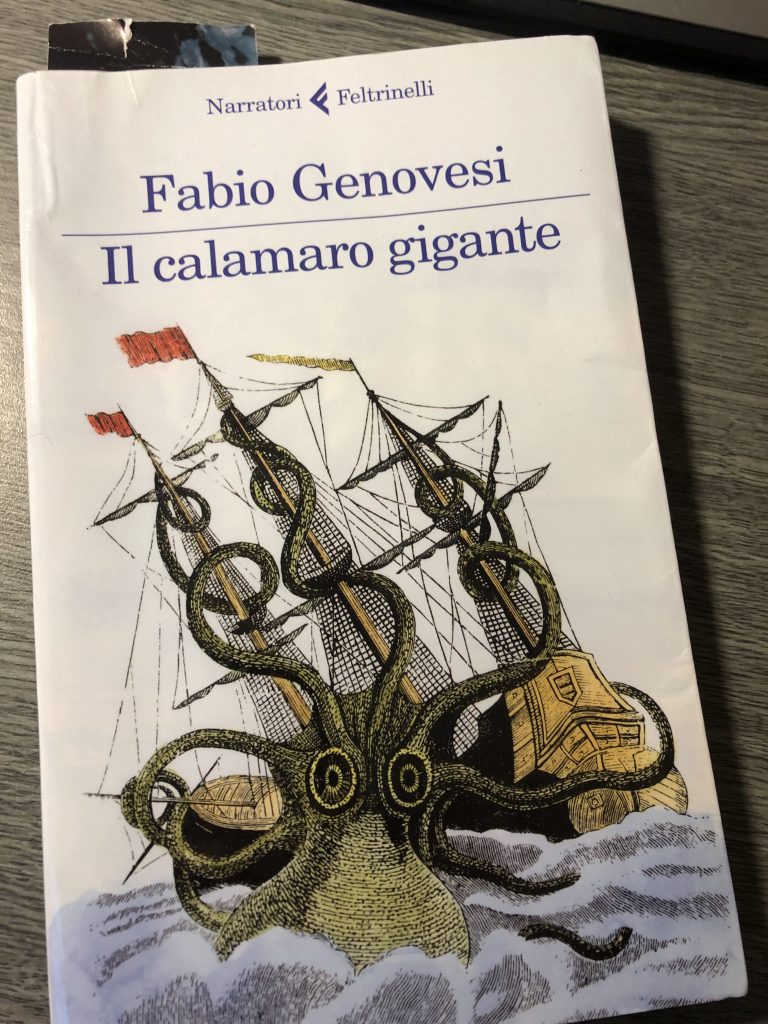
There, in the middle of nowhere, I found a book placed on a panoramic view over the valley below Monzuno, a book unknown to me, Il Calamaro Gigante. I opened it to a random page, with no idea of what I was doing, still lost in thought.
I found a startlingly reconciling answer for any kind of mental wandering.
But for that a separate story is needed, a dedicated article and a well-kept memory, because any walk holds much more for us than what we can expect.